Knowledge Graphs vs. Data Connectors
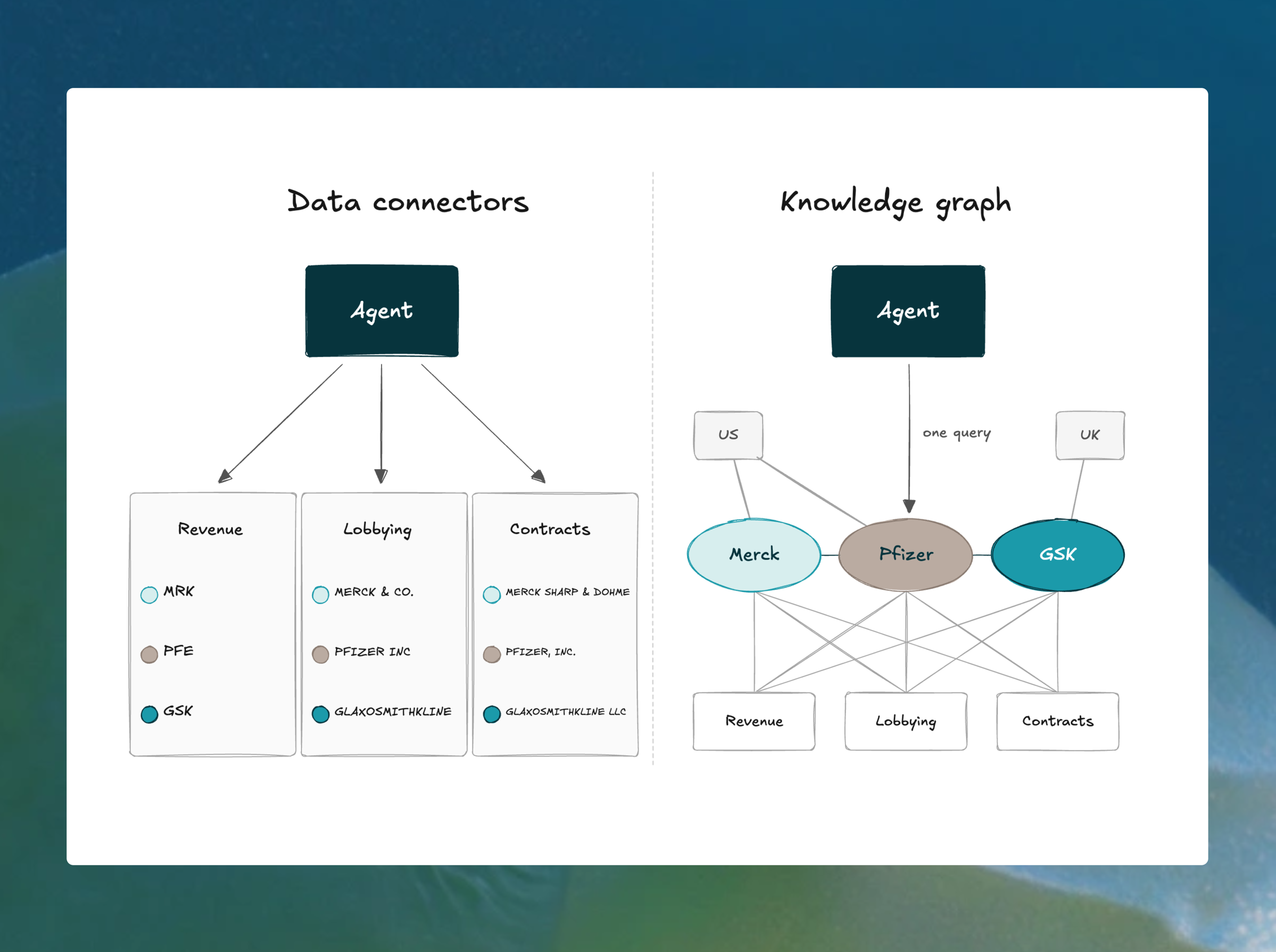
Structured data from premium sources is a critical ingredient to making agents more accurate and capable. Most agent web search companies have recently announced products that provide access to data (e.g. Exa Connect, Parallel Data Connectors, Firecrawl Alexandria).
Not all access is created equal. All of these implementations boil down to enabling agents to access data sources via API requests (e.g. MCP tools) rather than building them into an index. This sidesteps the hard search problem of identifying the right data source for a given query, but also relegates access to these data sources to expensive, asynchronous, and token-heavy long-running workflows.
They work in one of two ways: letting agents pay-per-tool-call to sources that historically required upfront fixed licenses, or manually configuring “external data connectors” which mimic or even reuse data providers’ MCP apps. The latter limits access to existing subscribers who want to access their entitled data via the web search agent’s interface. For most developers, the highest-value data stays locked behind expensive, complex licensing agreements.
Tako instead directly licenses, transforms, and indexes premium data into a knowledge graph. Deeply integrating data this way enables serving results at a fraction of the latency, does not require users to license data on their own, and provides clear, transparent pricing – all in a single interface with no data sources to configure.
Measuring the Performance Gap
To measure the differences in accuracy, cost, and latency, we crafted a queryset that targets verticals with the most overlapping coverage across all the data connector products. Today that primarily spans1 Companies, Macroeconomics, Government Spending, and Sports, which we’ve published as a new queryset on VerticalRTK. To focus the comparison on each product’s data source integrations, as opposed to grading each proprietary agent harness on its reasoning capabilities, we crafted the queryset to focus on fact retrieval rather than difficult multi-step reasoning tasks.2
- 1 To make it easy to reproduce this analysis, all providers were tested without integrations that require users to bring their own license.
- 2 Another area of overlap is web analytics. We deliberately omitted this as in our testing Exa charges roughly $3600 per 1000 agent runs, non inclusive of additional agent compute costs. For the same amount of data requested, Firecrawl charges $66 for 1000 agent runs. Parallel lists Similarweb as “coming soon” and we look forward to revisiting this comparison once that lands.
We evaluated performance in two cohorts, which measure each provider’s search API and its agent. First, we held the agent constant by giving a neutral agent harness each web search provider’s fast, non-agentic search API as its only tool. Second, we evaluated each provider’s agent endpoints, which are the only way to access the data through Exa Connect, Parallel Data Connectors, and Firecrawl Alexandria. Finally, we took a closer look at Companies, the vertical where the data connectors overlap most.
Neutral Agent Harness
To hold the agent constant, we used the Artificial Analysis Stirrup agent harness with a three-call budget for search requests on each leg, using the same provider configurations from the Artificial Analysis Search Index methodology. For Tako, the harness called Tako Search at fast effort with flat results on, up to 10 results per call.
View data
Search API accuracy and median latency in the same agent
Against Exa, the next most accurate and next fastest search API, Tako cuts latency by 23% and cost by 4%, and answers 57% more questions correctly. On pure retrieval tasks, search costs tend to dominate model costs. This means Parallel and Firecrawl may cost less per question, but Tako answers 73% more questions correctly than Parallel and more than twice as many as Firecrawl. Tako still sits on the Pareto frontier for accuracy and cost34.
- 3 The agent doesn’t always use up its full search budget of three, so pricing measures the average cost of a run inclusive of however many search requests were fired off.
- 4 Firecrawl pricing is variable based on subscription tier. Pricing is calculated based on the Standard annual plan credit pricing.
In latency-sensitive scenarios, the Tako knowledge graph is the only viable way to access the data. The Tako Search API queries both the web and the knowledge graph quickly, while the Exa, Parallel, and Firecrawl search APIs can’t reach their own data connectors.
Proprietary Agents
To test the agent APIs, each provider was configured with its default or recommended out-of-the-box experience (Exa Agent Auto, Parallel Task Core, Firecrawl Agent Default). Each agent was run with as many relevant data connectors selected as possible and asked to answer in text only.
View data
Agent accuracy and median latency
Against Exa Connect, the next most accurate agent, Tako’s Answer Agent cuts latency by 42% and cost by 94%, and answers 15% more questions correctly. It’s also 18% faster and 18% cheaper than Parallel Task, the fastest and cheapest competitor.
Moreover, in our testing we found that some agents often struggled to trigger their data connectors. None of Exa, Parallel, or Firecrawl exposes a way to explicitly trigger the data connectors, and even following Exa’s guidance of asking the agent to fetch data from a specific source via structured outputs had no effect.
Agents Not Required
Companies is the vertical with the most data connector overlap, so we wanted to take a closer look. Since the Tako Answer Agent and the non-agent Tako Answer API both search our knowledge graph, we included each in the comparison.
View data
Company questions: accuracy and median latency
When a question needs facts, not reasoning, Tako doesn’t make you bring an agent. Against Exa Connect, the next most accurate agent, the Tako Answer API answers 11% more company questions correctly, with 88% less latency and 95% lower cost. Even against Parallel Task, the fastest and cheapest competitor, it’s 87% faster and 64% cheaper. This is only made possible by deeply integrating data into the Tako knowledge graph.
The Anatomy of Data Search
Data search is a fundamentally different problem from web search. We model it as five phases, illustrated with an example in the figure below.
When using data connectors, an agent is tasked with figuring out how to perform each of these phases. However, each phase is also a potential failure point. Agents miss the right source when they have too many connections and tools, and they don’t know how to normalize the data in esoteric ways.
In fact, all of the data connector implementations we’ve analyzed push parts of Phase 1 beyond the agent and back onto the user. The user must specify the data connectors to enable in a given request (Exa, for example, limits a request to 5 at a time), and in many cases the user actually has to license the data themselves and bring their own API keys.
Tako resolves phases 1–3 when we ingest data into our knowledge graph. At a high level, this includes building a semantic understanding of each dataset, pulling it directly from its providers, and standardizing it across sources so agents can compare like with like.
Example: matching companies across sources
This has two enormous advantages, both reflected in the benchmark results. First, licensed data can be queried deterministically, without an agent in the loop, so more requests can run in less time and at lower cost. Second, agents that use the Tako knowledge graph can focus on analysis and computation, not on finding the data and working out how to retrieve it.
Don’t Bring Your Own License
One interesting feature of data connectors is that they allow users to easily connect additional data sources. Providers market this as flexibility, but data licensing is complex, expensive, and often comes with burdensome compliance requirements. Even after successfully licensing data, users and agents then need to wrestle with varying data formats, metric definitions, and entity resolution. After users license the data themselves, they’re better off tailoring an agent to that specific use case than bringing the data back to a generalist search agent.
A critical component of democratizing data access is building an experience that doesn’t require you to pursue a myriad of data licensing agreements, provides clear pricing on every request, and solves the hard data problems for you.
What’s Next
In this post we focused on access and retrieval of premium datasets, which only scratches the surface of the agentic capabilities this enables. We’re excited to share more deep dives into what that looks like in the near future.
Ground your AI agents in real-time, structured data — web and premium sources unified in one API. Try Tako in the Playground or .