Agents Need Structured Data for Data Work
Sending an agent to do deep research without structured data is like asking your best analyst to build a financial model from a pile of news articles. They might get there, but you’re paying for detective work before the analysis even starts.
Most data on the web is published for humans and exists in prose, charts, tables, and PDFs. An agent has to find the right page, scrape it, and extract the numbers. A single data-dense page can overflow its context.
Tako’s Search API returns web results alongside data results from our curated knowledge graph, and Tako’s Contents API makes the raw structured data behind data results directly available to agents.
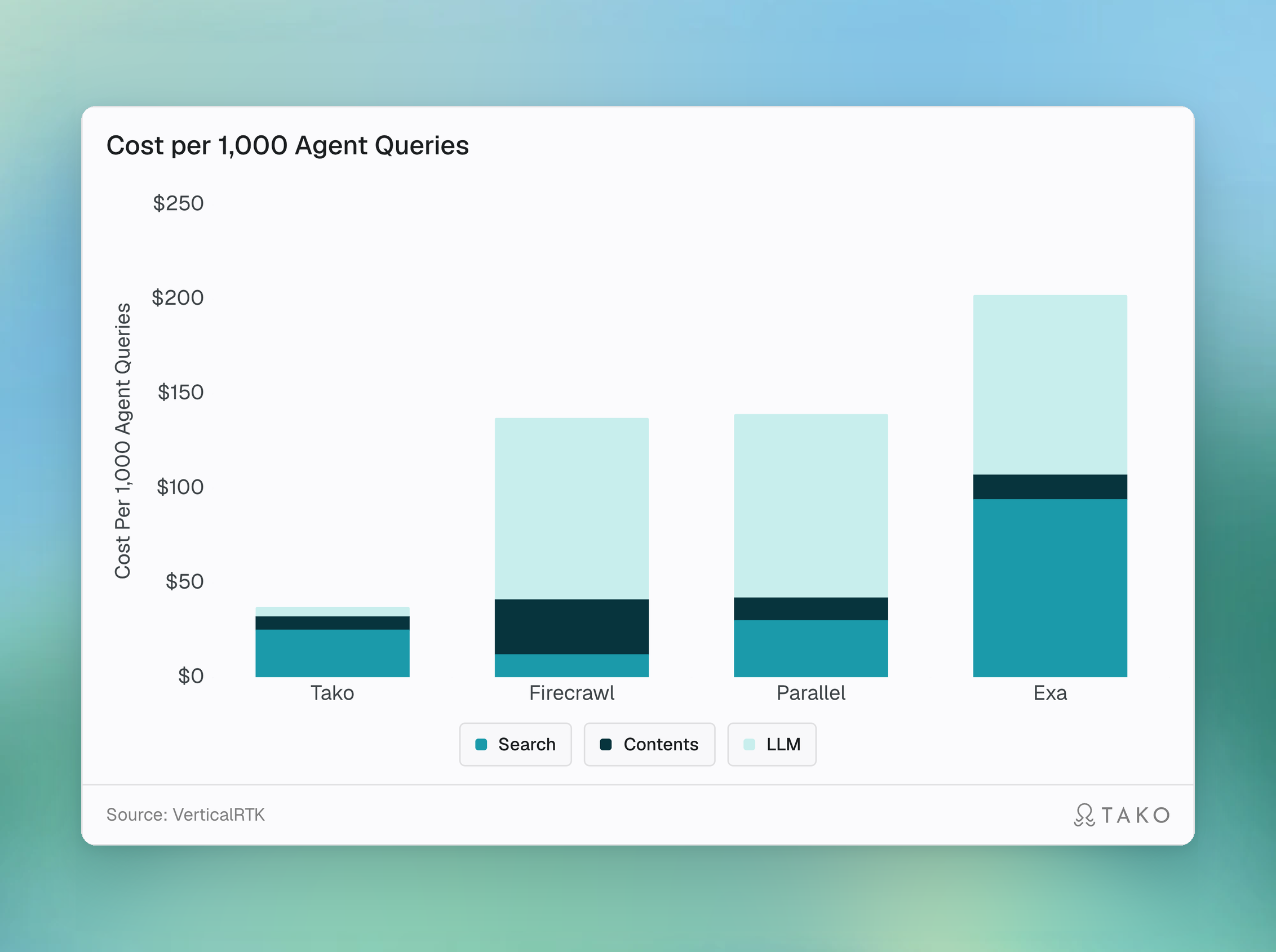
To measure the difference, we created a queryset of realistic data analysis questions and published it to VerticalRTK. The agent using Tako’s tool set cost up to 82% less and finished up to 84% faster compared to agents using Exa, Parallel, and Firecrawl.
This means when you ask for the “WTI crude oil price in March 2026,” you get a description of the data result alongside an embed-ready knowledge card.
Description: United States Crude Oil Price WTI's value was 91.38 USD/bbl in Mar 2026, up 298.5% since Jan 1986. Monthly data from Jan 1986 to Mar 2026, with a maximum of 133.88 USD/bbl in Jun 2008 and a minimum of 11.35 USD/bbl in Dec 1998.
Rows returned (488)
POST /v1/contents { "url": "https://tako.com/card/9JgfJtHTbSlgPciSdfrI/" }
Pass the card’s URL to the Contents API, and you get the full time series as a CSV.
Benchmark Findings
The agent with Tako’s Search and Contents tools operates on the raw structured data directly, letting it use fewer tool calls while completing its tasks the fastest.
View data
Analysis questions: cost per 1,000 agent queries, from the average cost per query
Against Firecrawl, the cheapest competitor, Tako is 73% cheaper, with 84% lower average latency, 77% fewer tool calls on average, and 95% fewer tokens on average. Against Exa, the fastest competitor on average, Tako is 80% faster, and against Parallel, which made the fewest tool calls, Tako makes 65% fewer.
Benchmark Design
For this experiment, we used the Artificial Analysis Stirrup harness with Search, Contents, and Code Sandbox tools. This allows agents to query for web and Tako knowledge graph results, fetch the full web page contents or the raw structured data, and execute Python code to analyze the data.
To match the Search and Contents APIs of each provider (Exa, Parallel, and Firecrawl), we first used each provider’s hosted MCP. That proved infeasible, as large, data-dense web pages often ran into the 10-million-character tool-call limit on OpenAI’s Responses API. Many runs also ran into the model’s context window ceiling and required compaction to continue.
We adjusted the benchmark by re-implementing each provider’s MCP tools as local tools, copying the same tool descriptions and input schema. For the Contents tools, we made each tool write its output to a file, in the same format as the provider’s MCP, instead of returning it into the model’s context. For Exa Contents, this meant a Markdown file, while for Firecrawl Scrape and Parallel Extract this meant a JSON file. For Tako Contents, this meant either Markdown for web pages, or CSV for knowledge graph results, which is the recommended way to use the API.
Each agent saw its provider’s MCP tool descriptions word for word, so it was up to the model to choose every call’s settings from those descriptions, such as how many results to return, which sources to search, and how much of a page or card to fetch.
Explore the Data
We built a visualization to explore the agent traces. In the following grid, each box represents a question in the queryset. Open any agent tool call to inspect it.
The agent with Tako’s tools searched the least, so it used the fewest tokens and finished fastest. The other agents also wrote extra code to clean and parse scraped web pages.
What’s Next
This post showed what Tako’s Contents API does for agents that analyze data. Data analysis is one of several capabilities that structured data search enables, and we’re excited to share even more use cases and examples in the future.
Ground your AI agents in real-time, structured data — web and premium sources unified in one API. Try Tako in the Playground or .