Evaluating a new kind of Search API
TL;DR
- Tako combines web search + premium structured data in a single API, giving agents comprehensive grounding from one call.
- On standard web-search benchmarks (SimpleQA and FRAMES), Tako matches leading web search APIs in both accuracy and latency.
- On reasoning- and precision-heavy benchmarks (FinSearchComp and VerticalRTK), Tako outperforms the next-best API by 21% on VerticalRTK.
- For agent research workflows, Tako reduces tool calls by up to 75% while delivering results at one-tenth the cost.
High-quality research and analysis depend on access to fresh, trustworthy information. A lot of mixed-quality information lives on the open web, and a new generation of AI web search APIs (e.g., Exa, Parallel) has emerged to help agents find, extract, and reason over web pages. Agents also need access to fresh, structured data to tackle a broader range of real-world research use cases: analyzing trends, building complete lists, constructing charts.
To an agent, web text and structured data solve the same problem: getting good information. But sourcing, ingesting, indexing, retrieving, and operating on trillions of structured data points demands a fundamentally different architecture than traditional web search does. Tako’s APIs combine web search and premium data search in a unified response payload to efficiently and accurately serve agents’ comprehensive grounding needs. Tako’s endpoints deliver unparalleled accuracy and efficiency compared with other web search APIs. In this post, we demonstrate those benefits across three categories of benchmarks:
- Established web-search benchmarks (SimpleQA, FRAMES)
- Deep-research benchmarks that require synthesis and reasoning across sources (FinSearchComp)
- VerticalRTK, our own benchmark focused on real-time, domain-specific knowledge
Tako performs at or above parity on established benchmarks and pulls significantly ahead on the harder questions that require reasoning and numerical precision to answer accurately.
Benchmarking the Status Quo
Standard benchmarks for evaluating web-search quality, like SimpleQA and FRAMES, consist of factual questions with a single verifiable answer.
“Who received the IEEE Frank Rosenblatt Award in 2010?” (SimpleQA)
These answers are widely reported across the web, and they do not change over time. We wanted to ensure that Tako’s combined web + data search endpoints perform at parity with web search APIs on both accuracy and latency.
We fetched search results from each provider’s API, synthesized an answer from the results with an LLM, and then used a separate LLM to judge the answer against the ground truth.
For each provider, default configurations were used. For more details, take a look at the harness used for this evaluation.
View data
FinSearchComp T3 accuracy by search API
From May 19th to May 23rd, 2025, what was the closing price (unadjusted) of Tesla in the U.S. stock market that week? How much higher/lower was it than that of Amazon? Keep 2 decimal places.
Answer: $339.34 — $138.35 higher than Amazon
On April 27, 2025, among Merck, TSMC (US stock), Boeing, IBM, and Goldman Sachs Group, which stock had a negative Price-to-Earnings ratio (TTM)? What was its P/E ratio (rounded to two decimal places)?
Answer: Boeing, at -11.51
For the Korea Composite Stock Price Index (KOSPI) from 2020 to 2024, in which year was the annual high the greatest, and what was that highest value in points?
Answer: 2021, at 3,316.08 points
What is the percentage change (unweighted) on the day with the highest single-day trading volume for NVIDIA (NVDA) between January 1, 2025, and March 31, 2025? Please provide the result rounded to two decimal places.
Answer: -16.97%
For each fiscal year from 2021 to 2024, what is Apple's inventory turnover rate as a multiple of Tesla's inventory turnover rate? (Round to two decimal places.)
Answer: 4.91 (2021), 5.95 (2022), 6.35 (2023), 4.94 (2024)
What were the research and development expenses of Uber for the full year 2019? (answer in millions of dollars, rounded to nearest integer)
Answer: $4,836 million
How much cash was used in financing activities by Apple in the 2021 fiscal year? (answer in millions of dollars, rounded to nearest integer)
Answer: $93,353 million
What was the closing price of Chicago corn for the July 2025 contract on December 28, 2024? (answer in cents/bushel, rounded to one decimal place)
Answer: 464.0 cents/bushel
What was the U.S. Housing Market Index (HMI) in November 2014? (answer rounded to the nearest integer)
Answer: 58
In April 2025, what was the Disposable personal income in the United States? (answer in billions of dollars, rounded to one decimal place)
Answer: $22,579.6 billion
In which year, month, and day was the Nokia 8110 announced?
Answer: 9 September 1996
What day, month, and year was Terraria patch 1.3.0.5 released?
Answer: July 13th, 2015
In which year was Ruth Wilson Gilmore honored with a mural painted in New Haven, Connecticut?
Answer: 2023
In which day, month, and year was the municipality of La Victoria, Boyacá, Colombia, founded?
Answer: December 21, 1956
A Tasmanian species of which plant genus was named after philanthropist Elisabeth Murdoch?
Answer: Boronia
If my future wife has the same first name as the 15th first lady of the United States' mother and her surname is the same as the second assassinated president's mother's maiden name, what is my future wife's name?
Answer: Jane Ballou
What sea borders the Irish County where the author of the short story Foster was born?
Answer: The Irish Sea
What is the name of the river in the city where Ikea's headquarters are?
Answer: The Oude Rijn
From 1924 to August 2024, how many times did Texas's and California's electoral colleges elect the same nominee during the presidential election?
Answer: 13 times
What is the name of the 2nd track on the album by Corinne Bailey Rae that came out 10 years before her album The Heart Speaks in Whispers?
Answer: Enchantment
On these conventional benchmarks, Tako performs at parity with the best web search APIs in both accuracy and latency.
In other words, combining web and data search incurs no accuracy or speed penalty on basic web-search benchmarks.
View data
Advertised search latency by API
VerticalRTK: Benchmarking More Serious Research Questions
Static Wikipedia-style trivia about the past ignores the kinds of queries agents actually need answered to perform economically valuable research tasks. Agents need quality, domain-specific information to handle these questions. To provide a more realistic measurement of search capabilities, we created our own benchmark — VerticalRTK.
This benchmark includes queries spanning multiple domains: finance, macroeconomics, sports, weather, and more. The queryset covers questions not commonly written about on the web, as well as questions with constantly changing ground-truth values like commodity prices and sports scores.
Each row in the set records when its answer was true and names the venue it came from, so the time-sensitive questions get re-sourced before a run rather than quietly going stale. The benchmark's own page covers how VerticalRTK is built and how its ground truth stays current, and the data ships under CC BY 4.0.
View data
VerticalRTK - Research accuracy by search API
As of market close on July 9, 2026, which of the 'Magnificent Seven' had the highest market cap, and how much bigger was it than the second-place company?
Answer: Nvidia, at about $4.91 trillion — roughly $266 billion ahead of second-place Apple
Among gold, silver, copper, and platinum, which had the largest absolute percentage price move (up or down) over the trailing year?
Answer: Silver, at roughly +55%
How did Estonia's military personnel count change by year from 1992 to 2020?
Answer: From 3,000 in 1992 to 7,000 in 2020, peaking at 8,100 in 2002–2003
How much has Palantir's market capitalization changed between January 1, 2023 and July 10, 2026, in both absolute and percentage terms?
Answer: From about $13.4 billion to about $304.0 billion — up roughly $290.6 billion, or about 22.8x
In which of the past five fiscal years did Costco's revenue growth rate exceed its membership fee income growth rate?
Answer: Fiscal 2021 (revenue +17.5% vs fees +9.5%) and fiscal 2022 (revenue +15.8% vs fees +9.0%)
After the Federal Reserve's first interest-rate hike of the current cycle on March 16, 2022, what was the maximum drawdown of the S&P 500 index over the following three months (March 16 to June 16, 2022), rounded to two decimal places?
Answer: About 20.83%, from the March 29 peak (≈4,631.60) to the June 16 trough (≈3,666.77)
We used the same LLM-synthesis and LLM-judge methodology as above to assess quality. When we evaluate search quality through this more realistic lens, Tako outperforms the next-best web search API by 21%.
Tako Makes Your Agents Smarter, Faster, and Cheaper
Web search excels at single-fact retrieval, but single facts are rarely sufficient for real analysis. When tasked with problems such as identifying outliers, projecting trends, or correlating findings, an agent needs a larger series of data. Tako’s APIs give access to the raw, structured data returned by search results, enabling agents to efficiently perform this novel type of analysis. This ultimately means fewer tool calls, lower token cost, and significantly lower latencies.
To concretely demonstrate this, we built a simple Research Agent harness and gave it the corresponding Search and Contents APIs of each web search provider as well as basic code execution functionality. The agent was then tasked with a research question using the various combinations of tools.
Agents equipped with Tako’s toolset consistently perform the research task more accurately while using up to 75% fewer tool calls, at as little as one-tenth the cost.
Compare Spain's and Vietnam's power-sector CO2 emissions since 2000. When did each country's emissions peak, and how far below its peak is each today? How many times larger are Vietnam's emissions now than in 2000? Has Vietnam overtaken Spain — and if so, in which year?
Run timeline


Fact-by-fact rubric
Run breakdown
Tako’s Agents Push the State of the Art Forward
Tako’s API primitives unlock a new class of capabilities for agents. Thanks to this, we’ve also been able to build our own proprietary agents on top of these primitives.
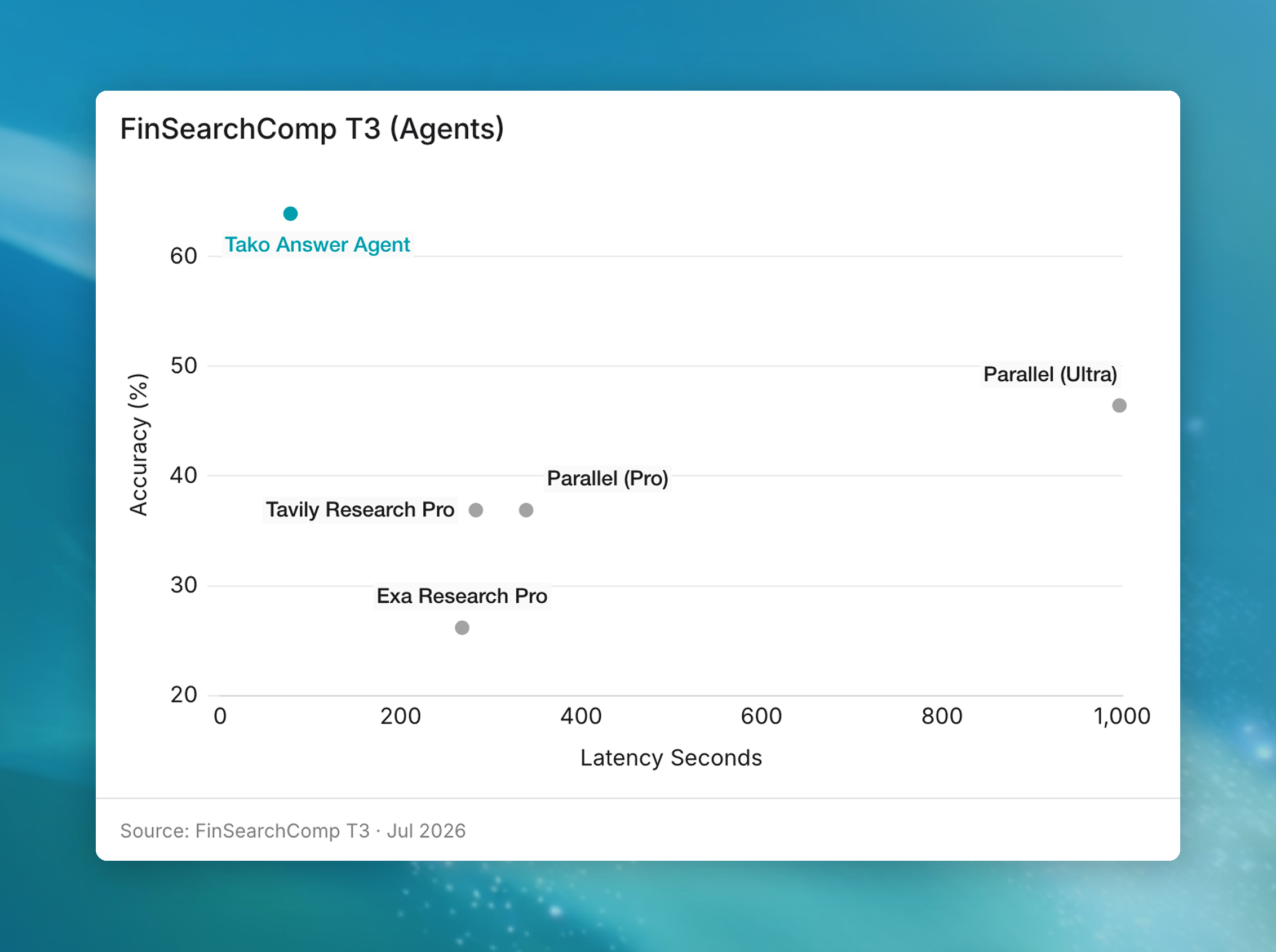
The Tako Answer Agent is able to plan a route through our knowledge graph and reason directly over the structured data it needs, performing analysis, synthesizing its research, and maintaining source provenance through citations as it works. This enables it to exceed state-of-the-art research capabilities at less than half the latency of competing systems.
View data
FinSearchComp T2 accuracy and time to answer by agent
What’s Next
We’ve released our Research Agent harness and published our set of realistic evaluations. There are even more facets of search quality that we’re constantly working on improving internally. In the future, we hope to share more on how we think about relevance alongside accuracy and go deeper on a wider range of data verticals.
Ground your AI agents in real-time, structured data — web and premium sources unified in one API. Try Tako in the Playground or .