Federal Contracts Data Is Public. Now It’s Usable in Tako.
We’ve added U.S. federal contract awards from the Department of the Treasury and open federal contract opportunities from the General Services Administration to Tako’s knowledge graph. That means you can look backward at where the government has spent money — and forward at what agencies may buy next. Ask questions like “Top Department of Defense vendors since FY2020,” “How much does NASA pay SpaceX a year?” or “What cybersecurity RFPs are currently open at the Department of Defense?” and get back an interactive chart or table you can inspect, share, and trace back to the source.
The data was already public. The hard part was making it usable.
USAspending.gov publishes detailed information on federal awards across agencies, recipients, industries, programs, and time periods. SAM.gov publishes active federal contract opportunities from contracting offices across the government. Anyone can search this data. But answering a seemingly simple question can still be surprisingly hard:
On the pre-award side, finding the opportunities that matter means working through agency and contracting-office hierarchies, notice types, response deadlines, NAICS and PSC classifications, set-asides, amendments, attachments, and inconsistent descriptions. The data is public. Turning it into a useful pipeline is the hard part.
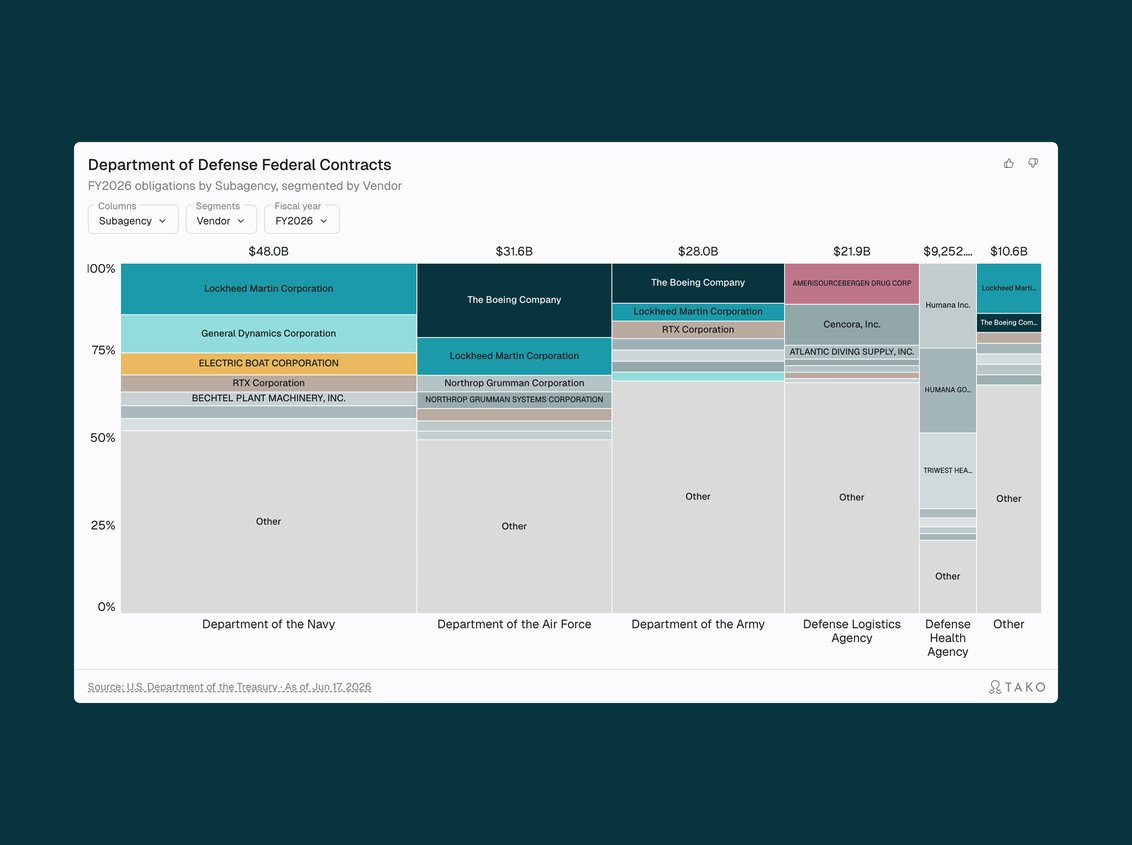
“How does the Department of Defense’s contract spending break down across its agencies and the vendors it pays?”
That sounds like one query. In practice, it involves bulk files, fiscal years, award identifiers, agency hierarchies, recipient entities, parent companies, contract modifications, de-obligations, and accounting concepts that are easy to misinterpret. What’s the difference between an obligation and an outlay? Why can a contract have negative obligations? The same contractor can appear under multiple legal names and subsidiaries — “Boeing” is not always one clean entity. Fiscal years don’t line up with calendar years. Agencies reorganize. Recipient identifiers change.
None of this is exotic. It’s just the unglamorous, easy-to-get-wrong work that sits between the data exists and I trust this number enough to use it. We did that work for you — ingesting federal contracts data into our knowledge graph with the normalization, reconciliation, and time alignment needed to make procurement data easy to query and compare. Here’s that exact question, answered — a single chart that crosses two dimensions at once, so you can see how the money splits across agencies and which vendors capture it within each:
Column width is each agency’s share of the total; the segments inside show the vendors it pays. And it’s one call to the Search API — hover View code on any chart to see the exact request.
Now you can ask
- Top 10 Department of Defense vendors by contract spending since FY2020
- Department of Defense contract obligations to Palantir over time
- NASA contract spending with SpaceX by fiscal year
- Lockheed Martin vs Northrop Grumman vs RTX federal contract spending
- Show Booz Allen’s federal contract exposure by agency
- Top industries by federal contract obligation
Each answer returns an interactive chart or table with the underlying data available to inspect — flip any chart to Data to see the exact rows behind it. A few examples — change the query string to ask your own:
Open RFPs are now live
Federal contract awards tell you what agencies bought and who won. Open RFPs tell you what they may buy next.
Tako now indexes active federal contract opportunities from SAM.gov alongside historical award data from USAspending.gov. You can search opportunities in natural language, narrow them by agency, topic, industry, set-aside, or response deadline, and open any result to inspect the original notice and its key details.
On agency pages, the new Open RFPs tab puts active opportunities next to the agency’s historical contract data — so you can move from understanding where the money has gone to finding opportunities that are open right now.
Now you can ask:
- Open Department of Defense RFPs for AI and machine learning
- NASA solicitations closing in the next 30 days
- Open cybersecurity opportunities set aside for small businesses
- What open RFPs does the Department of Veterans Affairs have for IT services?
- Show open solicitations under NAICS 541512
Each result surfaces the issuing agency, notice type, description, posting and response dates, NAICS and PSC classifications, set-aside information, and a link back to the original SAM.gov notice:
This connects historical spending to current pipeline in one workflow. Start with:
“Which agencies spend the most on cybersecurity services?”
Then ask:
“Which of those agencies have open cybersecurity RFPs right now?”
Instead of searching one system for past awards and another for active solicitations, you can explore both sides of the federal procurement lifecycle in Tako.
Compare companies side by side
Ask about several companies — or a whole cohort, like the major defense primes or the big cloud providers — and Tako groups the spend into a single comparison.
More ways to slice it
By company over time, by agency exposure, or by industry:
Get the underlying data
Every chart and table is backed by data you can pull. Pass a card’s URL to the Contents API to download a CSV of exactly what the chart is showing — no manual joins, no fiscal-year arithmetic.
Part of the broader research graph
Federal contracts data is useful on its own. It’s even more useful when it sits next to the rest of the market context. A contractor’s federal exposure now lives alongside its stock performance, financials, competitors, market position, public sentiment, web traffic, and broader macro or geopolitical context inside Tako. Start with “Who are the fastest-growing defense contractors since 2020?”, then ask “How have those companies performed in the public markets?” — not just to retrieve rows, but to make a complex web of data a single query away.
Built for analysts and agents
Agents are useful for reasoning, synthesis, and writing — but they shouldn’t guess at federal contracting trends from memory or web snippets. With Tako, an agent can retrieve historical federal contracts data, surface relevant open opportunities, compute the answer, generate a chart or structured table, and validate the provenance of every result. Federal contracts research can happen inside the same workflows where people already work: asking questions, comparing entities, building charts, and sharing findings.
Ground your AI agents in real-time, structured data — web and premium sources unified in one API. Try Tako in the Playground or .